
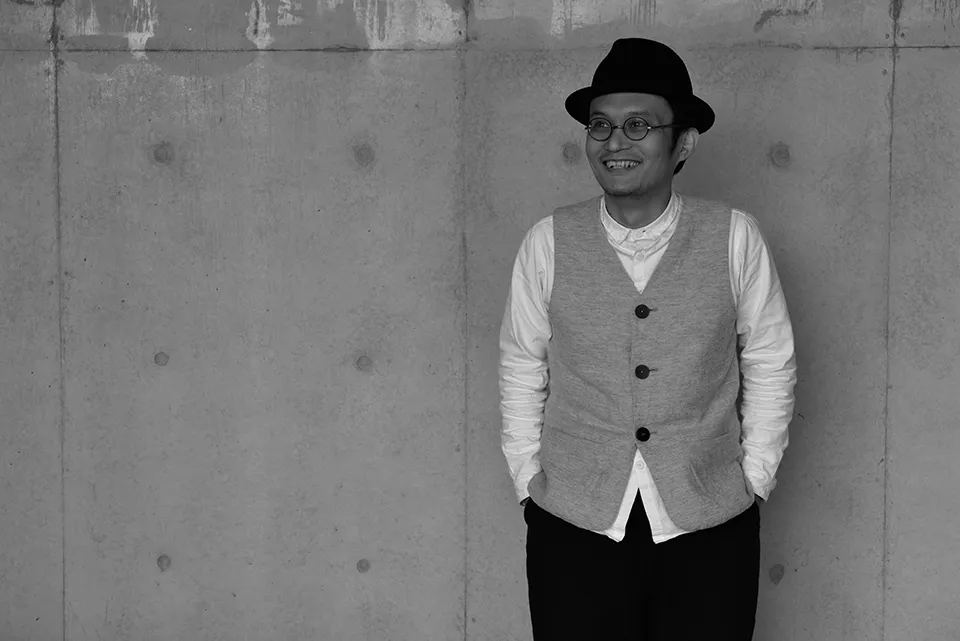
Kazuaki Harada
Harada Kazuaki
I make automata and games in Aio, a quiet town on the Seto Inland Sea in Yamaguchi, Japan. My wife Megumi and I run our workshop, Nizosha, and on the same grounds we also run a museum, a cottage, and a cafe.
Why all of it in one place? Let me tell you how it happened.
It started with a book a friend put in my hands — a collection by Akio Nishida, the pioneer of automata in Japan. I wanted to try making one myself, so I started in my spare time, while still working an office job.
About two and a half years in, I wanted it to be my work. I left my job and went to England, spent a year studying under the automata artist Matt Smith, then returned to Aio and set up a workshop.
At first I wasn't sure a person could make a living from automata in Japan. It's an unusual job, though, so journalists came by now and then, and orders slowly began to arrive. For years my work ran the same way: show pieces at craft fairs and galleries, take commissions there, and build them. Lately, more of what I make is for exhibitions at public institutions — science museums and the like.
At a solo show in Tokyo in 2020, alongside the automata I put out two things built with simple electronics: a shooting game called Virus Sniper, and Upending the Tea Table, played with radio-controlled robots. With an automaton, a visitor stands with the piece alone, turns the handle, and usually laughs quietly. With the games, visitors played against each other and the room got loud. That difference was new to me, and it felt like something worth following. Games have been part of my work ever since.
As the years went on there were more pieces, and bigger ones. I ran out of room and thought about putting up a storehouse. But rather than shut everything away, I wanted somewhere people could come and play with it all. That became musee AUTOMATON.
Once the museum opened, people began coming from outside the prefecture — and there are few places to stay around here. It's green and quiet on this land, so a cottage seemed like a good idea. That became nest AUTOMATON.
The museum, the cottage, the cafe. We use the singular — AUTOMATON — because the two of us, a couple who make automata, mean to raise it all as a single work.
Profile
- 1974 Born in Hikari, Yamaguchi
- 2002 Started making automata
- 2006–07 Studied under Matt Smith
- 2007 MA Contemporary Crafts, University College Falmouth (UK)
- 2008 Opened Nizosha studio in Aio, Yamaguchi
Selected exhibitions
- 2025 Kazuaki Harada's Automata and Chuya Nakahara Nakahara Chuya Memorial Museum, Yamaguchi
- 2024 Karakuri World, Taken Apart Yamaguchi Prefectural Museum
- 2023 Uutan Games Saga Prefectural Space & Science Museum (Yumeginga)
- 2021 Let's Play in Arima! Kazuaki Harada Arima Toy Museum, Kobe
- 2021 Dr. Karakuri's Strange Arcade Creative Space Akarenga, Yamaguchi
- 2020 Hanaseba Mijikakunaru B GALLERY, Tokyo
- 2019 Karakuri Exhibition Saga Prefectural Space & Science Museum
- 2018 Curious Contraptions Exploratorium, San Francisco
- 2015 The World of Automata Hofu Youth Science Museum Solar, Yamaguchi
- 2013 Karakuri Wonderland Aspirart, Yamaguchi
- 2013 Kazuaki Harada: Automata to Move and Play With Arima Toy Museum, Kobe
- 2013 Karakuri Festival Hamada Children's Museum of Art, Shimane
- 2008 PhantasieMechanik phaeno Science Centre, Germany